
April 2026
What modern employee development looks like from a manager's perspective: With practical tips for preparation, helpful perspectives for the interview and the foundations of psychological safety.

I still remember one of these annual development talks. I sat at the table with the prepared form in front of me, a list of points in my head that I absolutely wanted to address. My employee towards me, polite, somewhat tense, probably just as mediocre as I am.
I led through the conversation. Asked, followed up, steered. In the end, we agreed on a few goals, which — if I'm honest — revolved primarily around the weaknesses of the last assessment. A few weeks later, the log disappeared somewhere in the system. And only reappeared when the next appointment was due.
What irritated me back then was that no one was really satisfied afterwards. And yet I've done it the same way for years.
But there is another way.
Development does not come about when someone from outside says what should be better. It is created when people themselves understand what they want to work on — and why. This requires an inner drive and an eye for what is already there: your own strengths, interests, ambitions.
This also changes the role of leader. You no longer set the direction, but accompany. You listen, ask questions and help sort thoughts and make them concrete.
It sounds easy, but it isn't.
Because it means withholding your own solutions. Don't intervene immediately. Not providing the “right” answer. But to endure that the other person thinks for himself.
A good sign of this, by the way, is surprisingly banal: Who speaks more in conversation? If your employees have the majority of speaking time and you can tell that they are working themselves, then you're probably on the right track.
At this point, a legitimate concern often emerges: If employees manage their own development, won't that quickly become a desired concert? To goals that sound attractive but have little to do with the reality of the team or the company's priorities?
This is where your role as a leader becomes decisive. You set the framework in which development makes sense. A simple yet effective approach is to change your perspective using three “glasses” that you consciously bring into the conversation:

Sponsor:
What does this person need individually for their development right now? How can you provide specific support?

Team designer:
How does this development topic affect team collaboration and cooperation?

Entrepreneur:
What difference does this development make for the company? Where does this create real added value?
The aim is to reconcile these three perspectives — the needs of the person, the team and the company. This is the only way to achieve development goals that are realistic and feasible.
In practice, there is often a very simple hurdle: Many employees don't even know where to start. What do I actually want to work on? Where does my potential lie? And which of them is really relevant right now?
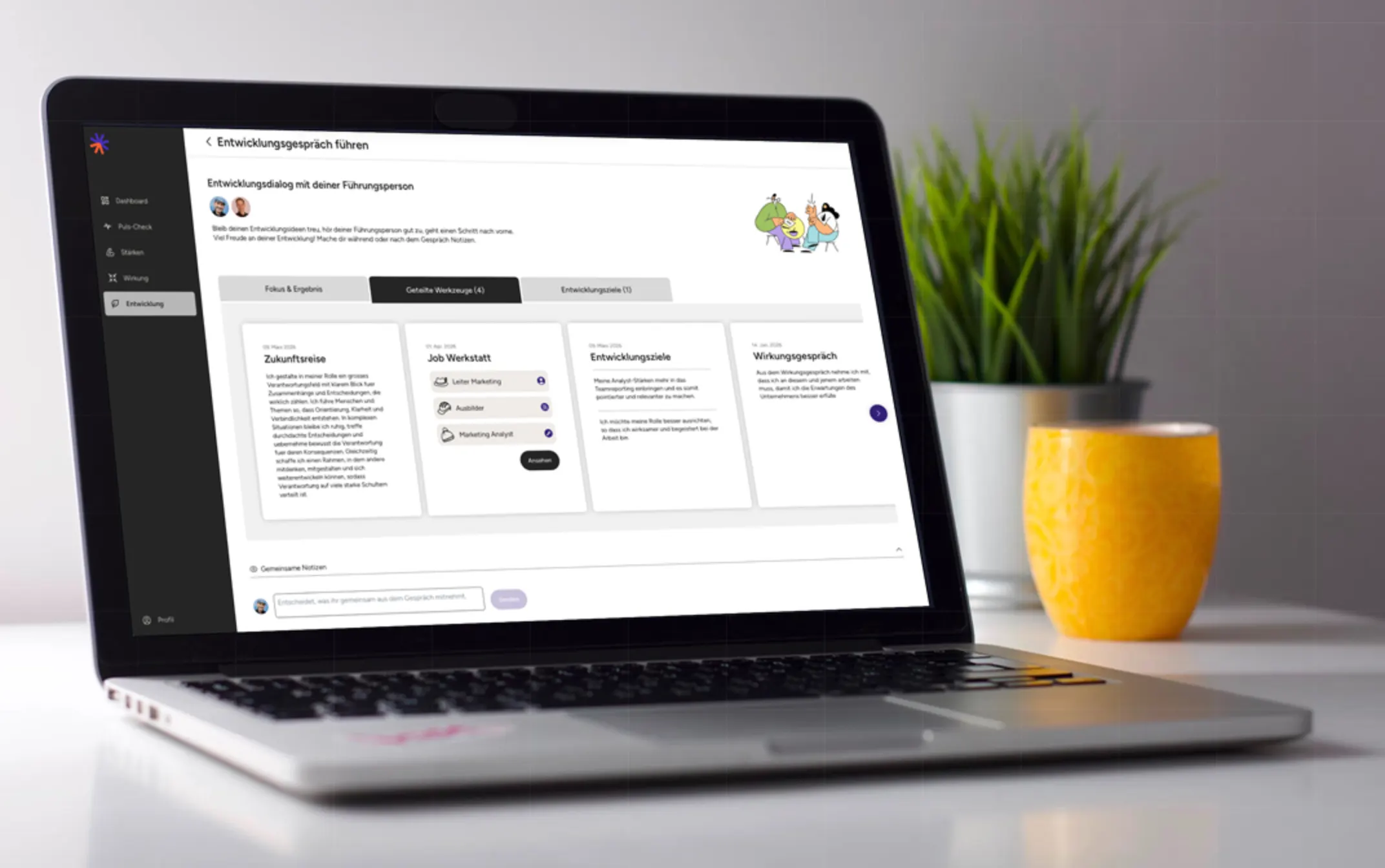
We have put together three approaches that have proven effective in everyday life, provide orientation and make the first steps tangible. Each person decides for themselves which of them fits right now. And as a manager, you can accompany the process — by asking questions, reflecting and providing structure.

360° Impulses
Get new perspectives from people who experience you in everyday life — for your personal development with a view to the future.
Job workshop
Consider your active roles and evaluate them according to the criteria: a) I enjoy and b) Am I effective. Then design your roles so that they fit you and your organization's goals even better.
Journey to the future
Imagine where you would like to be in 2-5 years. Think about what is important to you then and where you have developed. Then create a picture of the future that gives you orientation about the coming period.
When employees take on more responsibility for their own development and you take on a stronger role as a coach, the basis for effective discussions is laid. But how can this be implemented in practice in everyday life?
Here are a few practical approaches that have proven effective:
Separation of performance and development:
Deliberately separate development discussions from performance assessments. This creates a space that is not about evaluation, but about genuine engagement with development.
Become a sparring partner:
See yourself as someone who accompanies, thinks along and sometimes critically follows up. Not as someone who pretends, but as a counterpart, which helps to create clarity and stay tuned.
The example of Ewl Energie Wasser Luzern shows that this approach works. The company is the leading energy service provider in the region and is a pioneer of a sustainable corporate strategy that focuses on customers and employees.
Fabienne Frank, Co-Head of HR, describes the change as follows:
“Thanks to the new approach, our development talks have gained significantly in depth. I need less time to prepare and I feel that I am closer to my employees' important topics. ”
What is often underestimated is that in order for such conversations to develop depth at all, a certain degree of security is required in the exchange.
People only open up when they have the feeling that they can also say something unfinished. That it's okay not to be able to do something yet or to be uncertain. You create the framework in which development is possible by showing that questions are welcome. That experiments are allowed. And that even small steps mean development.
When development becomes an integral part of everyday working life and is no longer perceived as a mandatory annual deadline, development is achieved with commitment and leads to healthy, sustainable performance teams.
The wyrd app accompanies and supports development for managers and employees in everyday life. With tools for reflection, clear objectives and structured preparation of development talks. This is supplemented by short instructions that explain the underlying methods in a comprehensible way and make them easy to use. This is how good development works!
Would you like to bring modern employee development into everyday life for your team?
Try it out. Good luck!
Write to us hey@wyrd.io — we are looking forward to the exchange!


